The Natural Beauty of Shetland Yarns

Plus, How to Make a Dorset Button Video + Bonus Pattern ‌ ‌ ‌ ‌ ‌ ‌ ‌ ‌ ‌ ‌ ‌ ‌ ‌ ‌ ‌ ‌ ‌ ‌ ‌ ‌ ‌ ‌ ‌ ‌ ‌ ‌ ‌ ‌ ‌ ‌ ‌ ‌ ‌ ‌ ‌ ‌ ‌ ‌ ‌ ‌ ‌ ‌ ‌ ‌ ‌ ‌ ‌ ‌ ‌ ‌ ‌ ‌ ‌ ‌ ‌ ‌ ‌ ‌ ‌ ‌ ‌ ‌ ‌ ‌ ‌ ‌ ‌ ‌ ‌ ‌ ‌ ‌ ‌ ‌ ‌ ‌ ‌ ‌ ‌ ‌ ‌ ‌ ‌ ‌ ‌ ‌ ‌ ‌ ‌ ‌ ‌ ‌ ‌ ‌ ‌ ‌ ‌ ‌ ‌ ‌ ‌ ‌ ‌ ‌

The Natural Beauty of Shetland Yarns

The colors of Shetland's sheep are a great source of knitterly inspiration. Hear how Gudrun Johnston uses naturals in color-filled palettes. Read online.

By: Kate Larson

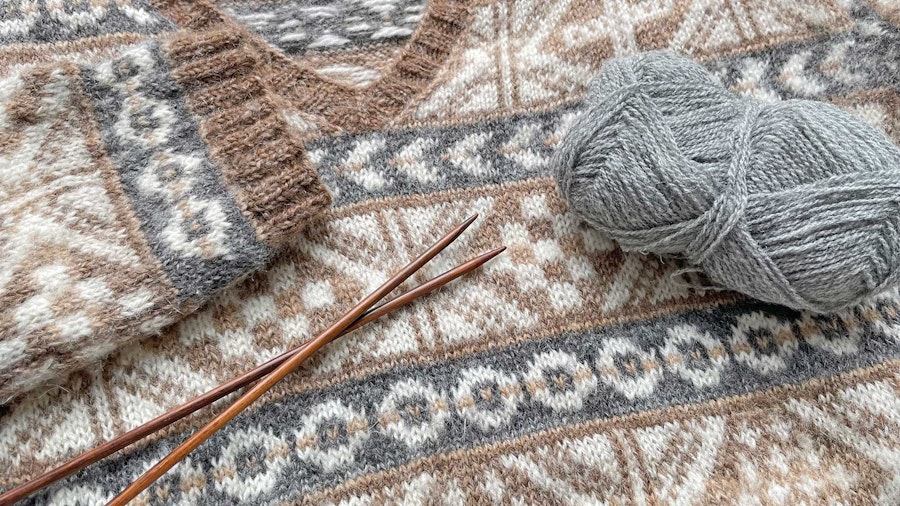
Kate's Fair Isle jumper knitted in five natural sheep shades. Photo by Kate Larson

The native sheep of the Shetland Isles are often described as a "primitive" breed, meaning that they retain many of the characteristics of their hardy ancestors. The first thing that often turns our knitter's heads, of course, is their beautiful fleece colors.
 

Many Shetland sheep colors and color patterns are still identified by old names, tracing their roots to Old Norse. Some names, such as shaela (gray) and moorit (reddish brown), are still used by shepherds and yarn companies alike. However, there is evidence of a rich language of terms for patterns and colors in Norn—a dialect that predated the Shetland dialect spoken today—that has been lost.

The Spindrift yarn line from Jamieson's of Shetland carries natural shades as well as plied naturals that create a marled effect. Courtesy of Jamieson's of Shetland/Simply Shetland

Curious about using undyed natural-color yarns or heathered neutrals inspired by natural color wool for colorwork? Trust me—it doesn't have to be all beige!

Go All In: Sheep Shades

I love the challenge of an all-natural sheep-shade palette for color stranding projects. The Fair Isle jumper above only has five colors, but, from a distance, some of the colors can appear to shift depending on their neighbor colors.
 

Much of the strategy behind a successful stranded palette relies on value—the relative lightness or darkness of the colors. If you are new or new-ish to color stranding, choose background colors and pattern colors with a strong value difference. This is easy to check with a gray-scale filter on your camera.

Check the contrast between your background and pattern colors by viewing your swatch in black and white. Photo by Kate Larson

You can see here that the brown and gray yarns appear nearly the same when viewed in gray scale, so I separated them in the design. Even one row of light tan between the central motif (brown) and the border patterns (gray) helped in this case.

A Natural Buffer

Naturals can be just the thing you need to balance out a stranded colorwork project that uses dyed colors or heathers. Naturals can create breathing space and allow more saturated colors to stand out. I asked Shetland-born color aficionado Gudrun Johnston to weigh in on using natural colors in her color-stranding work. Gudrun is the brand manager for Simply Shetland, the US distributor for Jamieson's of Shetland. Her work frequently draws on the natural range of Jamieson's Spindrift colors.

Gudrun in the Paul Klee sweater by Midori Hirose (left) and the half-hap version of her Hansel pattern available on Ravelry (right), both knitted in Jamieson's Spindrift, distributed by Simply Shetland. Photos courtesy of Gudrun Johnston

Gudrun says, "I find that when working on larger stranded knitting projects, where a lot of the main color will show, my inclination is often to start with selecting a natural shade. It works well as a palette cleanser and really provides the best kind of neutral base from which to then pick from an infinite selection of dyed colors.

"I also apply this to knitting Shetland haps (shawls), where instead of colorwork you have stripes of color in the border sections where old shale lace is worked. Those natural shades can really let the contrast colors pop beautifully in the fabric."

Links

Jamieson's of Shetland
Midori Hirose
Laurenson, Sarah, Ed. Shetland Textiles: 800 BC to the Present. Lerwick, Shetland: Shetland Heritage Publications, 2013.
Simply Shetland

--

Gudrun Johnston is a Shetland-born, US-based knitwear designer who has joined the Simply Shetland team as brand director. Find her on Instagram @gudrunjohnston and @simply_shetland.
 

Kate Larson, editor of Spin Off, teaches handspinning around the country and spends as many hours as life allows in the barn with her beloved flock of Border Leicesters.

More Stories & Patterns You'll Love

Explore your new digital source for knitting expertise, fiber stories, farm explorations, and more. Join us in exploring the world of natural fiber, must-knit designs, and the essential community of knitters. 

SUBSCRIBER EXCLUSIVE
How to Make a Dorset Button Video + Bonus Pattern

For three hundred years, intricately patterned buttons were produced in Dorset, England. These small, soft buttons made by wrapping linen thread around a wire ring were common during Jane Austen's day.  Watch now.

SUBSCRIBER EXCLUSIVE
Bonus Podcast: Felicia Lo, SweetGeorgia

In this subscriber-exclusive bonus podcast, Felicia Lo shares her advice on how to choose colors for a knitting project, explains why SweetGeorgia maintains a variety of yarn bases, and shares what's on her own needles. Listen now.

Bluebell Flames Shawl

The patchwork effect of entrelac often provides a canvas
for color-changing yarns, but Hannah Poon uses the
technique's back-and-forth rhythm to add a sweet and
subtle lace motif to this generous wrap. Continue reading.

Thank you launch sponsors:

Long Thread Media serves content for the handspinning, handweaving, and traditional needlework communities online, in person, and in print. The company was founded to publish HandwovenPieceWork, and Spin Off, as well as offer information, education, and community to crafters in those fields. 

From the bottom of our hearts, thanks for being part of this venture with us. 

To make sure you keep getting these emails, please add support@farmfiberknits.com to your address book. Not interested in knitting? Unsubscribe.


1300 Riverside Ave, Ste 206, Fort Collins, CO, 80524

Comments

Popular posts from this blog

Indigo: Weaving with the Color of Calm

Plus, What's So Great about Fulling?  ‌ ‌ ‌ ‌ ‌ ‌ ‌ ‌ ‌ ‌ ‌ ‌ ‌ ‌ ‌ ‌ ‌ ‌ ‌ ‌ ‌ ‌ ‌ ‌ ‌ ‌ ‌ ‌ ‌ ‌ ‌ ‌ ‌ ‌ ‌ ‌ ‌ ‌ ‌ ‌ ‌ ‌ ‌ ‌ ‌ ‌ ‌ ‌ ‌ ‌ ‌ ‌ ‌ ‌ ‌ ‌ ‌ ‌ ‌ ‌ ‌ ‌ ‌ ‌ ‌ ‌ ‌ ‌ ‌ ‌ ‌ ‌ ‌ ‌ ‌ ‌ ‌ ‌ ‌ ‌ ‌ ‌ ‌ ‌ ‌ ‌ ‌ ‌ ‌ ‌ ‌ ‌ ‌ ‌ ‌ ‌ ‌ ‌ ‌ ‌ ‌ ‌ ‌ ‌ You do not currently have a subscription to Little Looms under this email. Please consider  subscribing today. Indigo: Weaving with the Color of Calm By: Kate Kilmurray Kate Kilmurray writes about how she uses indigo-dyed loops and a simple potholder loom to create a mindful and meditative weaving experience.   Continu e readin g. What's So Great about Fulling? By: Christina Garton Have you ever wondered why we full wool fabrics? As it turns out, fulling is an important part of the finishing process.  Continue reading. How to Throw a Dye Party By: Yvonne Ellsworth Who loves a party? I know I do, especially if it is a dye party. I have hosted and participated in dozens of dye parties over the years, and I am here to tell you how it...

The Best (and Worst) Ways to Weight Floating Selvedges

It may make you a better weaver.  ‌ ‌ ‌ ‌ ‌ ‌ ‌ ‌ ‌ ‌ ‌ ‌ ‌ ‌ ‌ ‌ ‌ ‌ ‌ ‌ ‌ ‌ ‌ ‌ ‌ ‌ ‌ ‌ ‌ ‌ ‌ ‌ ‌ ‌ ‌ ‌ ‌ ‌ ‌ ‌ ‌ ‌ ‌ ‌ ‌ ‌ ‌ ‌ ‌ ‌ ‌ ‌ ‌ ‌ ‌ ‌ ‌ ‌ ‌ ‌ ‌ ‌ ‌ ‌ ‌ ‌ ‌ ‌ ‌ ‌ ‌ ‌ ‌ ‌ ‌ ‌ ‌ ‌ ‌ ‌ ‌ ‌ ‌ ‌ ‌ ‌ ‌ ‌ ‌ ‌ ‌ ‌ ‌ ‌ ‌ ‌ ‌ ‌ ‌ ‌ ‌ ‌ ‌ ‌ You do not currently have a subscription to Handwoven under this email. Please consider  subscribing today The Best (and Worst) Ways to Weight Floating Selvedges By: Christina Garton Throughout my 10 years or so of weaving I've used many items to weight my floating selvedges and/or broken warp ends. Some have worked beautifully and some not so much. Here, in my opinion, is where they stand from least to most useful Binder Clip Clipped to Something Heavy-ish For this first method, I tied the floating selvedges around the handle of a large binder clip and then clipped it to something with a bit of heft, I'm not sure exactly what. It didn't matter, of course, because this worked terribly. This method came from me not being able to find ...

Wild Hand is a place for fiber folk - thoughtful supplies for weavers, spinners, knitters, crocheters and more!

They offer materials, education, and community to encourage curiosity for fiber craft: weaving, crochet, knitting, felting, spinning, dyeing, knotting, stitching, fleece processing, and more!  ‌ ‌ ‌ ‌ ‌ ‌ ‌ ‌ ‌ ‌ ‌ ‌ ‌ ‌ ‌ ‌ ‌ ‌ ‌ ‌ ‌ ‌ ‌ ‌ ‌ ‌ ‌ ‌ ‌ ‌ ‌ ‌ ‌ ‌ ‌ ‌ ‌ ‌ ‌ ‌ ‌ ‌ ‌ ‌ ‌ ‌ ‌ ‌ ‌ ‌ ‌ ‌ ‌ ‌ ‌ ‌ ‌ ‌ ‌ ‌ ‌ ‌ ‌ ‌ ‌ ‌ ‌ ‌ ‌ ‌ ‌ ‌ ‌ ‌ ‌ ‌ ‌ ‌ ‌ ‌ ‌ ‌ ‌ ‌ ‌ ‌ ‌ ‌ ‌ ‌ ‌ ‌ ‌ ‌ ‌ ‌ ‌ ‌ ‌ ‌ ‌ ‌ ‌ ‌ Sent in partnership with Wild Hand Wild Hand is a community that believes in the magic of fiber craft: to bring together people who share a vision of an imaginative and just world. Visit Wild Hand in Philadelphia or at wild-hand.com for thoughtfully sourced supplies, workshops, events, and retreats for weavers, spinners, knitters, crocheters, felters and more! Use code WILDTHREAD for 15% Off Through 11/15 Shop hand-dyed yarns and fibers at Wild Hand! Philia Fiber Co. is a Philadelphia-based dye house creating truly one-of-a-kind yarns by hand. Ritual Dyes hand-dyed Mohair/Silk yarn is a ...